7 Vocal EQ Live Moves That Instantly Remove Mud & Add Clarity
Vocal EQ Live is where most mixes are won or lost. If your vocal sounds muddy, harsh, thin, or buried, the problem is usually in a few predictable frequency zones — and you can fix it fast with the right cuts and controlled boosts.
This guide gives practical Vocal EQ Live starting points that work in real rooms: churches, clubs, outdoor stages, and full band mixes.
Vocal EQ Live Quick Reference (Featured Snippet Target)
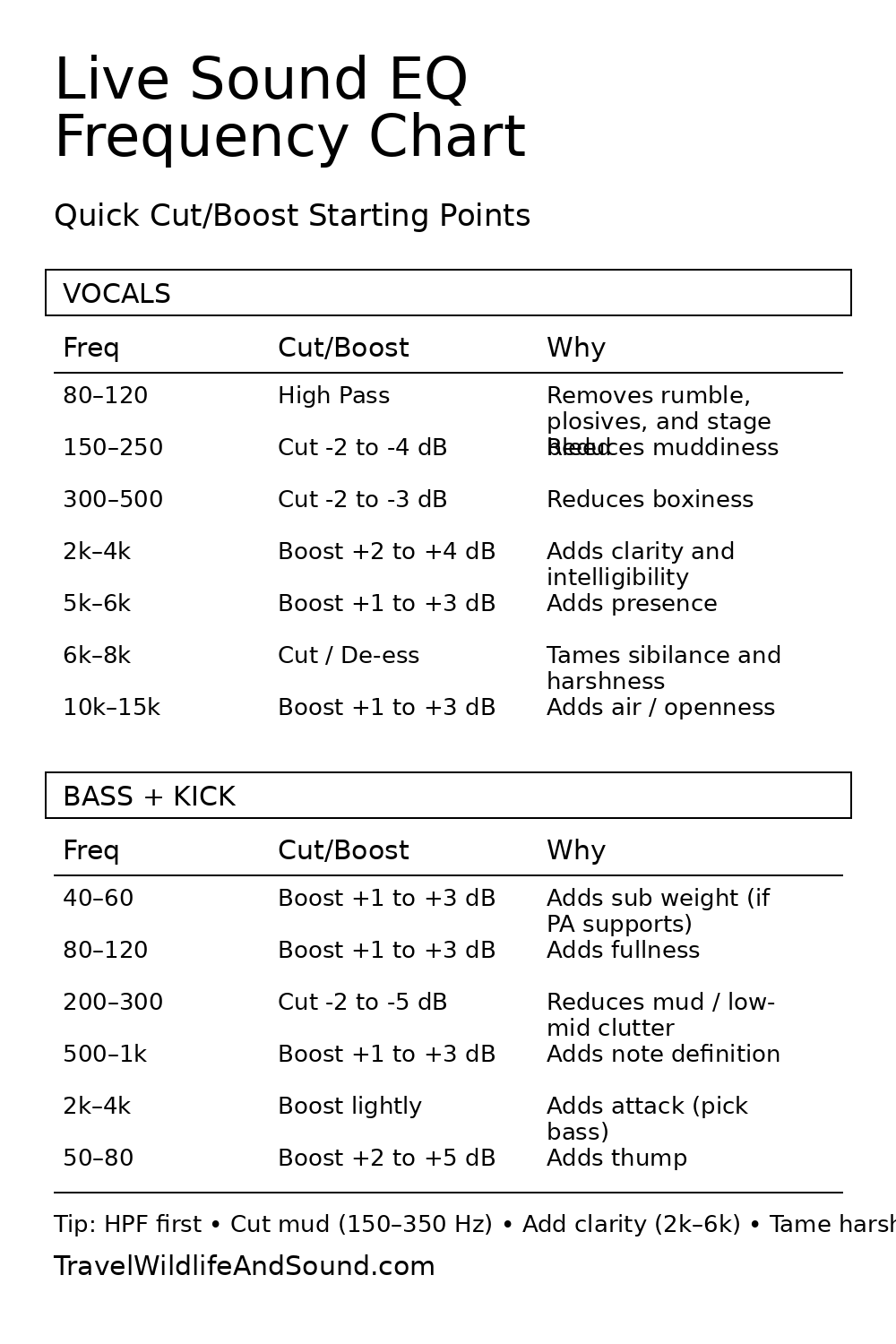
- 80–120 Hz → High-pass to remove rumble and stage bleed
- 150–250 Hz → Cut to remove mud
- 300–500 Hz → Cut to reduce boxiness
- 2k–4k Hz → Boost lightly for clarity and intelligibility
- 5k–6k Hz → Add presence
- 6k–8k Hz → Control harshness / sibilance
- 10k–15k Hz → Add air / polish
Free Printable EQ Chart + Visual Reference
Want a quick reference you can keep in your gig bag? Download the full printable chart (PDF) and the vertical image version:
Download Printable Live Sound EQ Frequency Chart (PDF)
View the Pinterest Vertical EQ Frequency Chart Graphic
Rich Media: Vocal EQ Live Chart Image
1) High-Pass Filter First (80–120 Hz)
Start Vocal EQ Live with a high-pass filter. This removes stage rumble, mic handling noise, HVAC noise, and low-end bleed from kick and bass. Most live vocals do not need anything below 80–120 Hz.
2) Remove Mud (150–250 Hz)
Mud is the #1 live vocal problem. If the vocal feels cloudy or “blanketed,” make a gentle cut between 150–250 Hz. In small reflective rooms, mud can extend closer to 300 Hz.
3) Reduce Boxiness (300–500 Hz)
Boxiness makes vocals sound hollow and trapped. A small cut in the 300–500 Hz range often opens vocals up dramatically.
4) Add Clarity (2k–4k Hz)
This range helps intelligibility. A small boost between 2k–4k Hz lets the vocal cut through guitars and cymbals without just turning the fader up.
5) Add Presence (5k–6k Hz)
Presence gives the vocal “front-of-mix” energy. Boost carefully — too much can make vocals feel edgy.
6) Control Harshness & Sibilance (6k–8k Hz)
If the vocal sounds sharp, brittle, or “spitty,” check 6k–8k Hz. Use a small cut or de-essing if needed. This is a common harshness zone in live mixes.
7) Add Air (10k–15k Hz)
A subtle high-shelf boost can add polish and openness. Use lightly, especially with bright microphones.
Want the Full Chart for the Whole Band?
This Vocal EQ Live guide is part of our complete reference hub. For full frequency charts covering vocals, electric guitar, acoustic guitar, bass, kick, snare, and toms:
Live Sound EQ Frequency Chart (Free Printable)
Common Vocal EQ Live Mistakes
- Boosting high frequencies before cutting mud/boxiness
- Skipping the high-pass filter
- Over-boosting 3k–6k (causes fatigue fast)
- Using the same EQ on every singer and mic
FAQ – Vocal EQ Live
What is the best starting point for Vocal EQ Live?
High-pass at 80–120 Hz, cut 150–250 Hz for mud, reduce 300–500 Hz for boxiness, then add clarity around 2k–4k Hz only if needed.
Why does my live vocal sound muddy?
Mud usually builds between 150–350 Hz and gets worse from room reflections and stage bleed.
Should I boost or cut first in Vocal EQ Live?
Cut problem frequencies first (mud/boxiness), then add small boosts for clarity and presence if necessary.
Additional Live Sound Resources
For more live mixing education and EQ concepts, see: